
Flowers enlarged until they appear almost unreal, silent landscapes dominated by dark mountains, animals isolated across immense surfaces: Anne Loch’s painting captivates through its immediate beauty before unsettling the viewer’s gaze. Behind these familiar motifs lies a demanding body of work poised between figuration and abstraction.
Although she spent many years at a distance from the art world, the German artist developed an extensive body of work over almost four decades. The exhibition Anne Loch. Painting: So What? presents almost 80 works, including several monumental canvases rarely shown to the public.
This selection offers a glimpse into a much larger body of work comprising some 1,400 paintings, alongside drawings, photographs, texts and video pieces. It is only the second major exhibition devoted to Anne Loch in Switzerland, following the presentation held at the Bündner Kunstmuseum in 2017.
Familiar subjects made monumental
A yellow flower stands out against a blue sky. A flock of sheep stretches across more than three metres. A peony, a butterfly or a raven’s head occupies almost the entire surface of a canvas.
Anne Loch chose simple, instantly recognisable subjects: flowers, animals, mountains and landscapes. Yet their altered scale profoundly changes the way we perceive them. Enlarged to monumental proportions, these motifs lose their apparent familiarity and acquire an almost unreal presence.
A flower is no longer simply a flower. A landscape no longer merely represents a place. As the viewer approaches the canvas, the forms begin to dissolve, the painted surface reveals itself and the image shifts between figuration and abstraction.
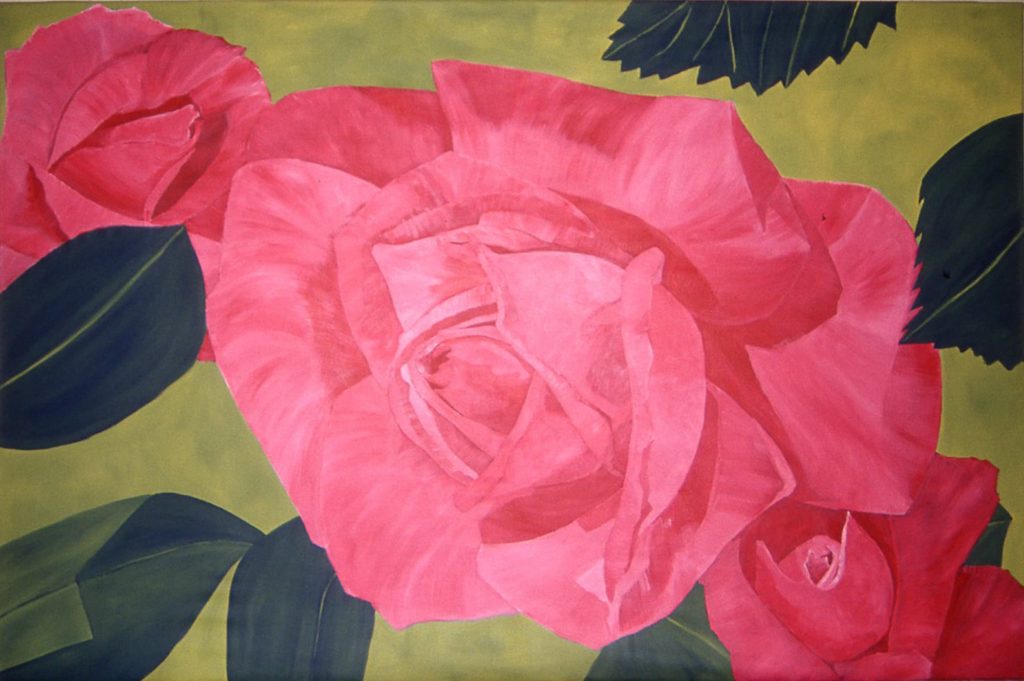
Anne Loch
AL 279, 1989
Acrylique sur toile
180 × 280 cm
BKW Energie AG Bern
Photo : Dominique Uldry, Berne
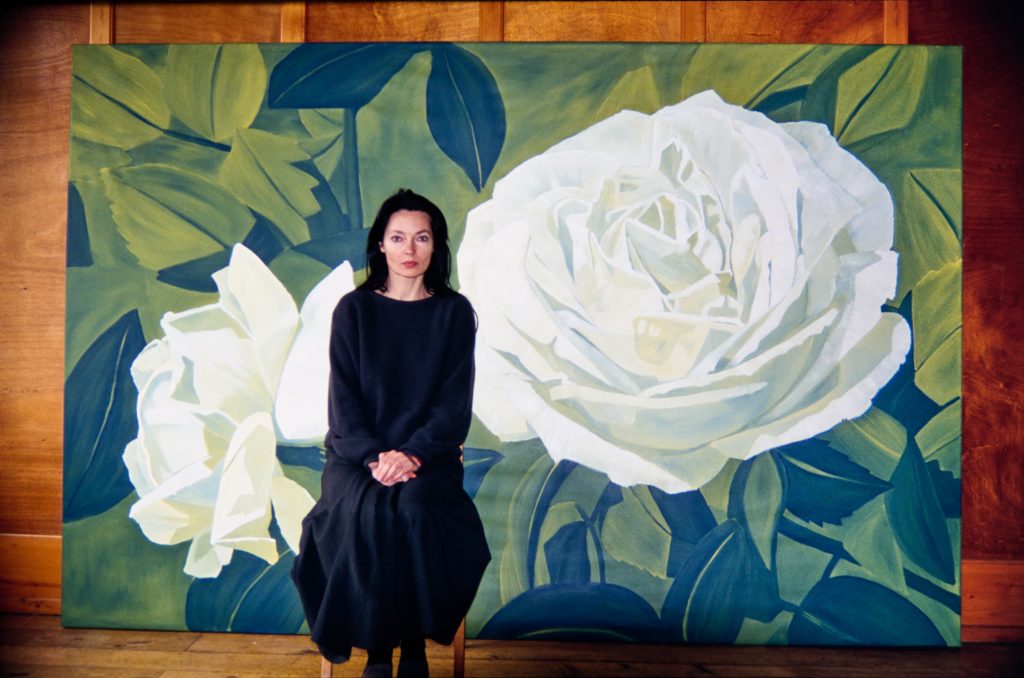
Anne Loch dans son atelier à Thusis, 1989
Succession Anne Loch
Photo : Christoph Guler, Thusis
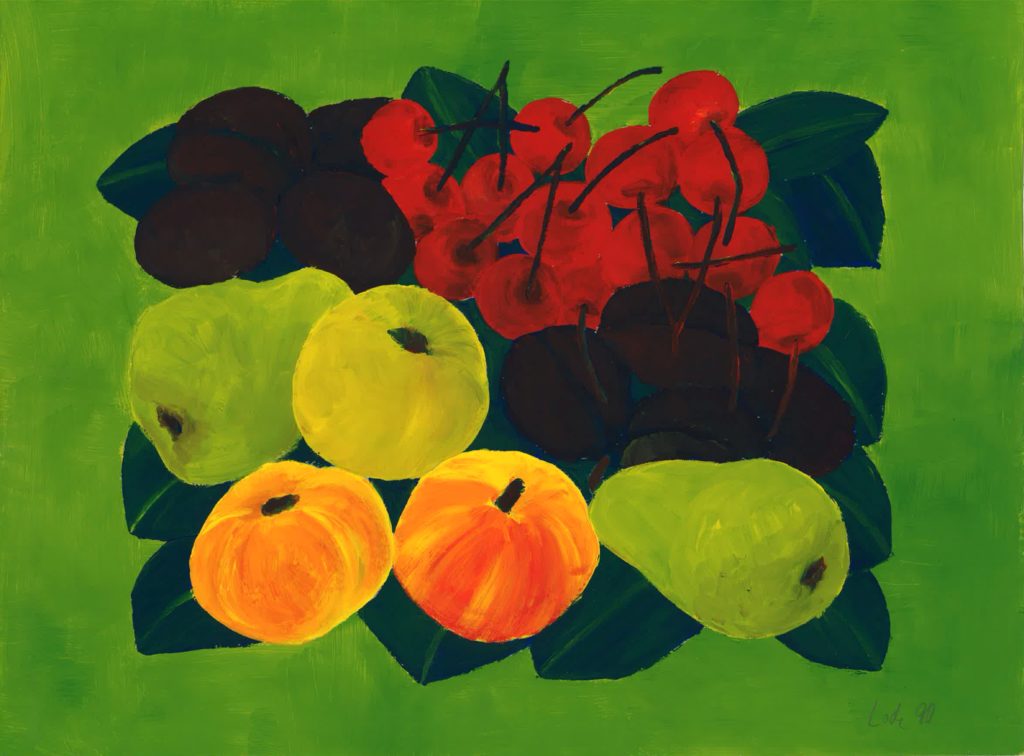
Anne Loch
AL 356, 1990
Gouache sur carton
30 × 40 cm
Collection privée
Photo : Dominique Uldry, Berne
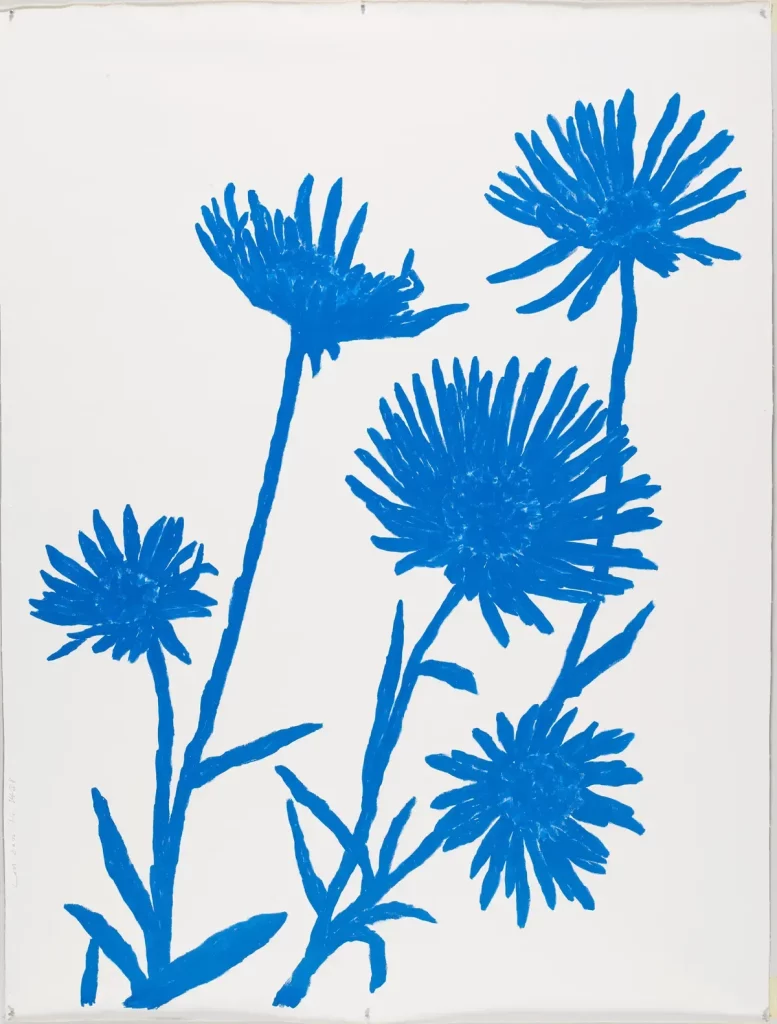
Anne Loch
AL 1438, 2010
Acrylique sur toile
210 × 160 cm
Succession Anne Loch
Photo : Dominique Uldry, Berne
From Cologne to the Swiss mountains
Anne Loch’s career began in the 1980s at the heart of Cologne’s art scene. She was represented by the prestigious gallerist Monika Sprüth, alongside artists who would become major international figures, including Rosemarie Trockel, Jenny Holzer, Barbara Kruger and Cindy Sherman.
At a time marked by the revival of figurative painting in Germany, Anne Loch occupied a distinctive position. Her landscapes and floral compositions stood apart from the gestural and neo-expressionist works of her contemporaries.
Everything seemed to point towards a brilliant career. Yet in 1988, the artist made a radical decision: she left the Rhineland and moved to Thusis, in the Swiss canton of Graubünden. She broke away from the Cologne art world and began to lead an increasingly secluded life.
This distance did not slow down her creative work. Quite the opposite. Anne Loch worked tirelessly, away from public attention, and developed a remarkably abundant body of work over almost forty years. She exhibited only occasionally, notably with Galerie Friedrich in Bern.
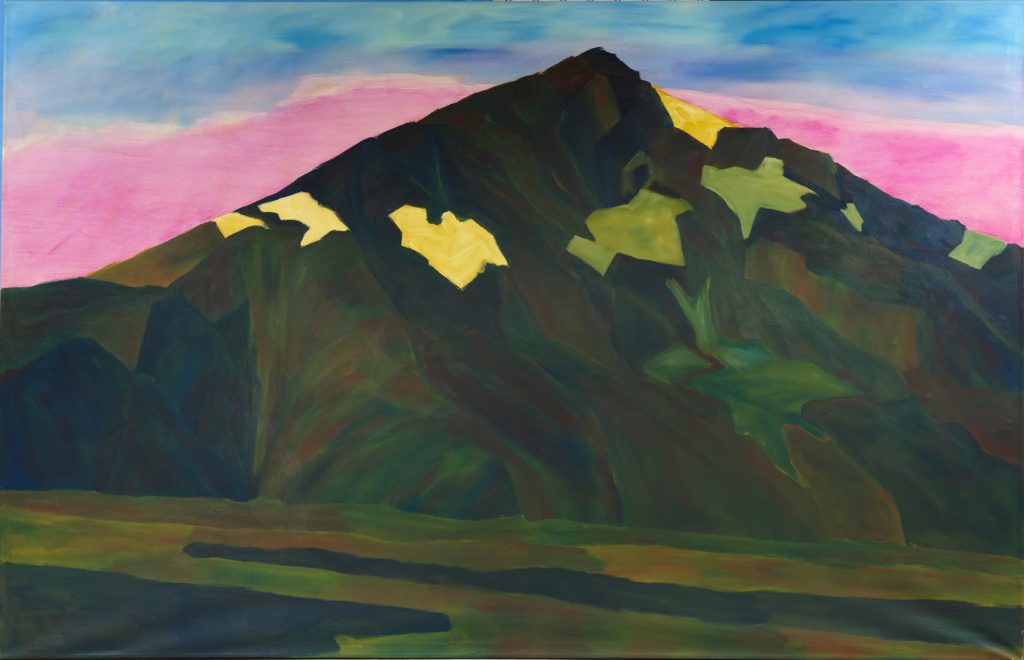
Anne Loch
AL 213, 1987
Acrylique sur toile de coton écrue
180 × 280 cm
Succession Anne Loch
Photo : Dominique Uldry, Berne
Between beauty, strangeness and kitsch
The vivid flowers, animals and landscapes chosen by Anne Loch could easily have slipped into the decorative or the kitsch. Yet behind their immediate beauty lies a rigorous, carefully constructed and sometimes disconcerting form of painting.
The artist did not work spontaneously. Her compositions were meticulously prepared from photographs taken during walks, in her studio or sometimes from images seen on television. The framing and structure of each picture were established before the first brushstroke touched the canvas.
From a distance, the colours appear vivid and saturated. The subject seems obvious. Up close, this certainty begins to blur: the paint is applied in thin layers, sometimes allowing the raw canvas to remain visible. The image fragments, leaving the viewer face to face with the surface of the painting itself.
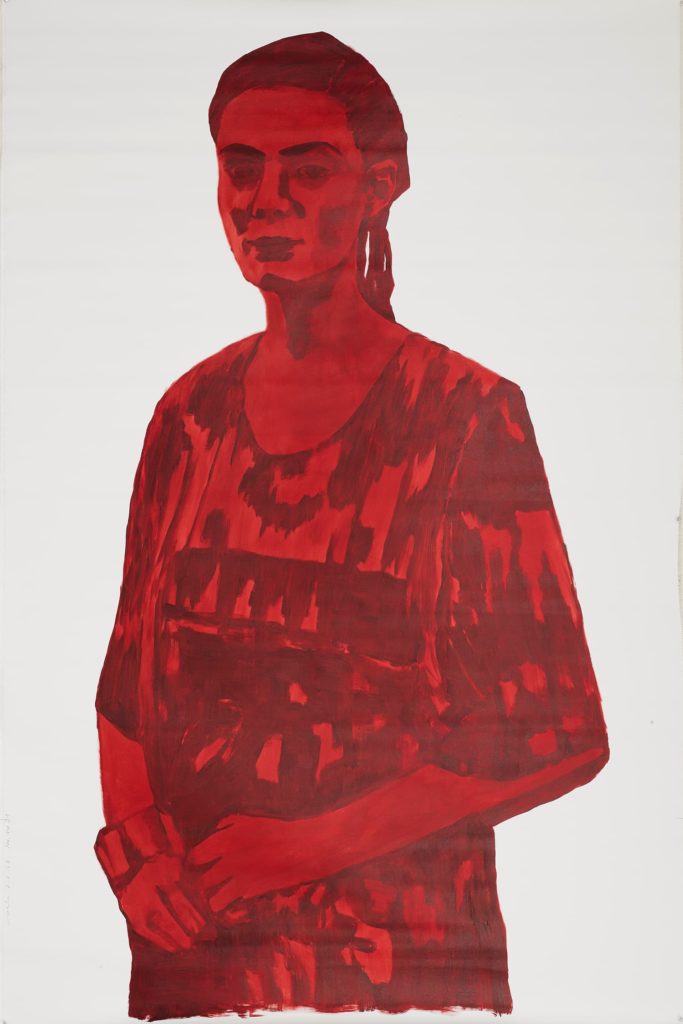
Anne Loch
AL 1431, 2010
Acrylique sur toile
240 × 155 cm
Succession Anne Loch
Photo : Dominique Uldry, Berne
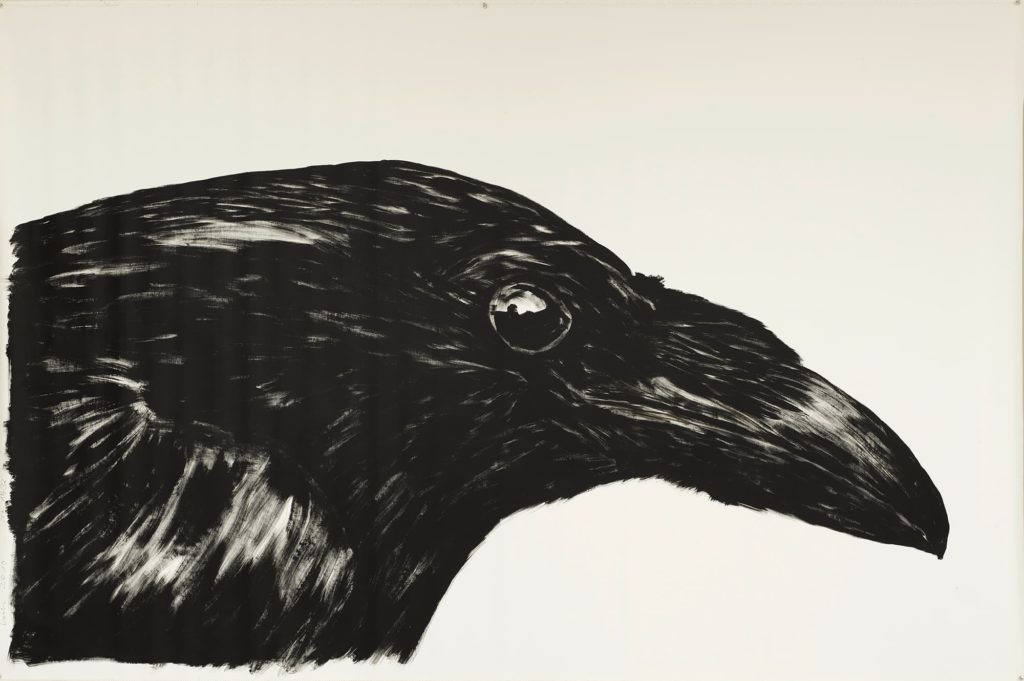
Anne Loch
AL 1432, 1997
Acrylique sur toile
150 × 235 cm
Collection BONDO
Photo : Dominique Uldry, Berne
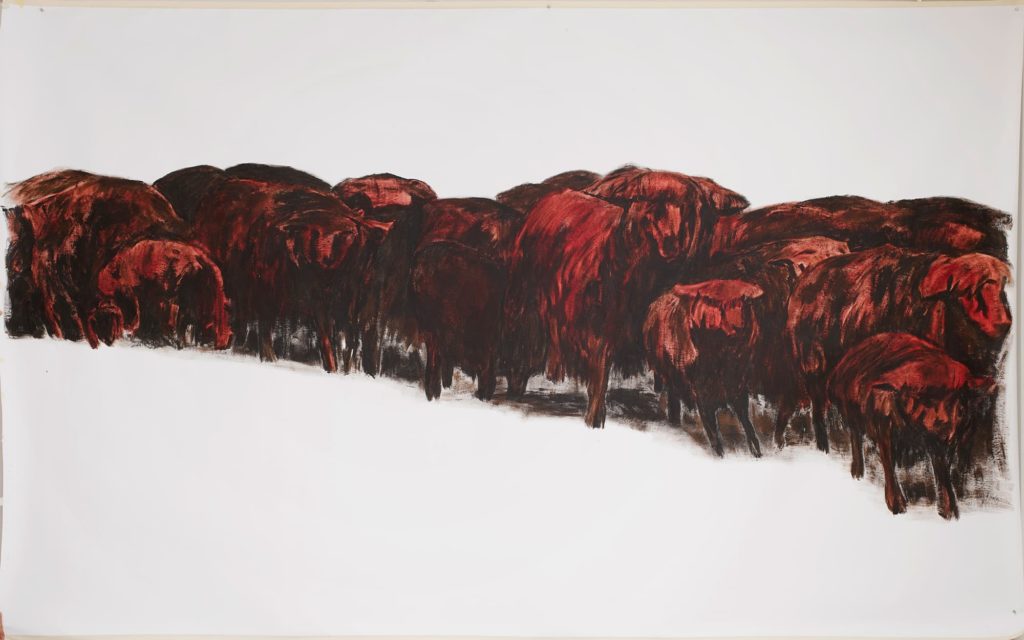
Anne Loch
AL 1308, 2007
Acrylique sur toile
215 × 360 cm
Succession Anne Loch
Photo : Dominique Uldry, Berne
Painting without telling a story
Anne Loch was wary of the interpretations and narratives that viewers often seek to project onto a work of art. She had no desire to comment on current affairs or produce social criticism. Her interest lay elsewhere: in the relationships between lines, colours, surfaces and spaces.
Her motifs therefore became starting points. Once transferred onto the canvas, they broke free from their real-life models. Painting no longer simply reproduced the world; it became an autonomous experience.
This is perhaps where the full strength of her work lies. Behind seemingly traditional subjects, Anne Loch questions what we see and how an image is constructed. Where does representation end? At what point does a flower become an abstract form? Can we look at a landscape without trying to recognise a specific place?
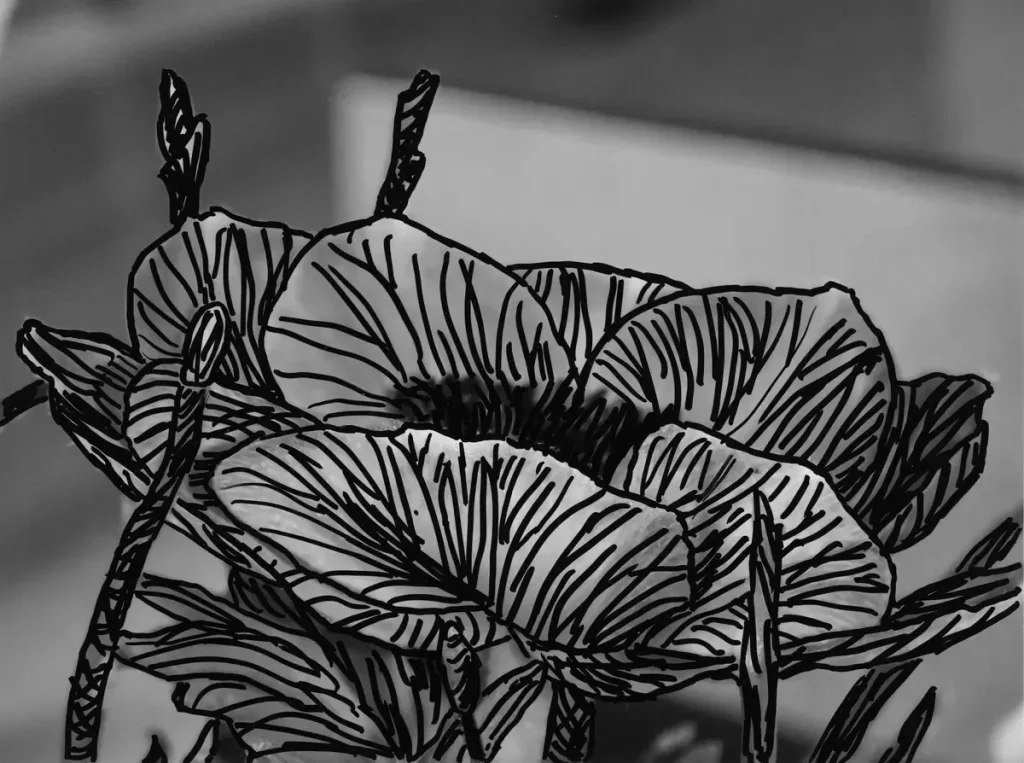
Anne Loch
AL Spino 5, 2014
Surligneur permanent sur photographie en noir et blanc
27 × 20 cm
Collection privée
Photo : Dominique Uldry, Berne
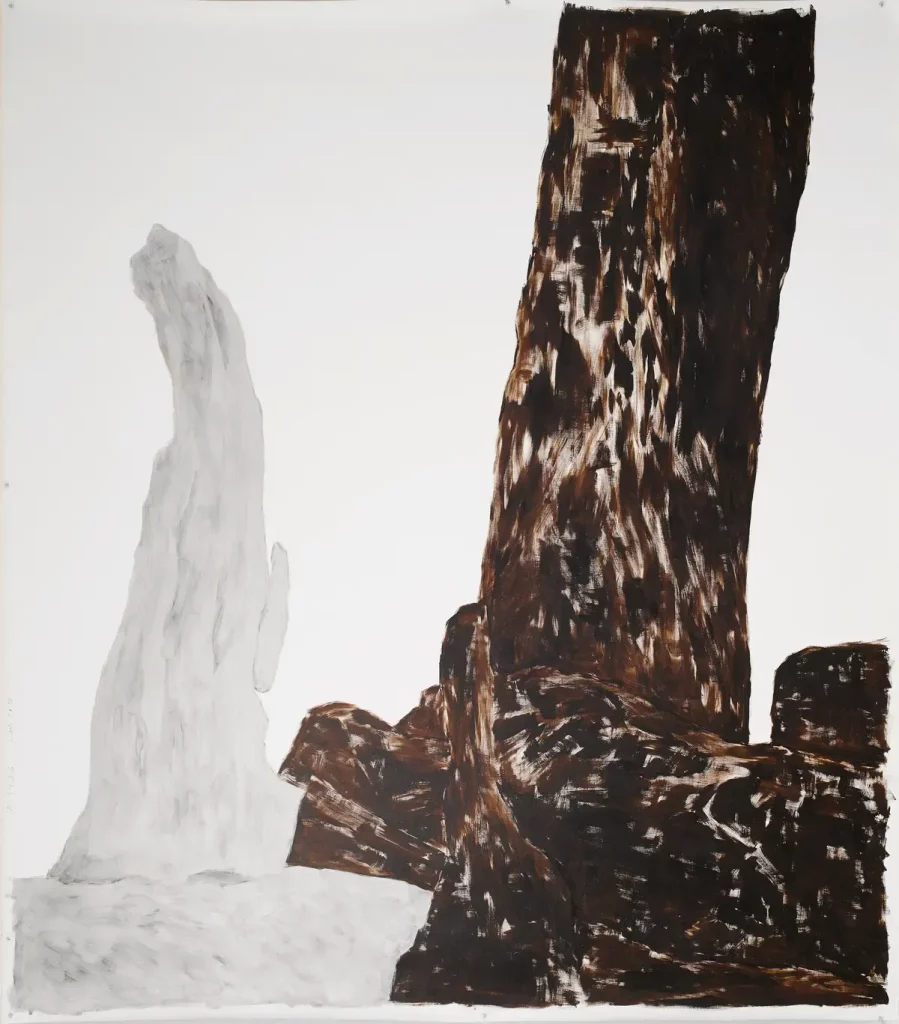
Anne Loch
AL 1436, 2010
Acrylique sur toile
240 × 220 cm
Succession Anne Loch
Photo : Dominique Uldry, Berne
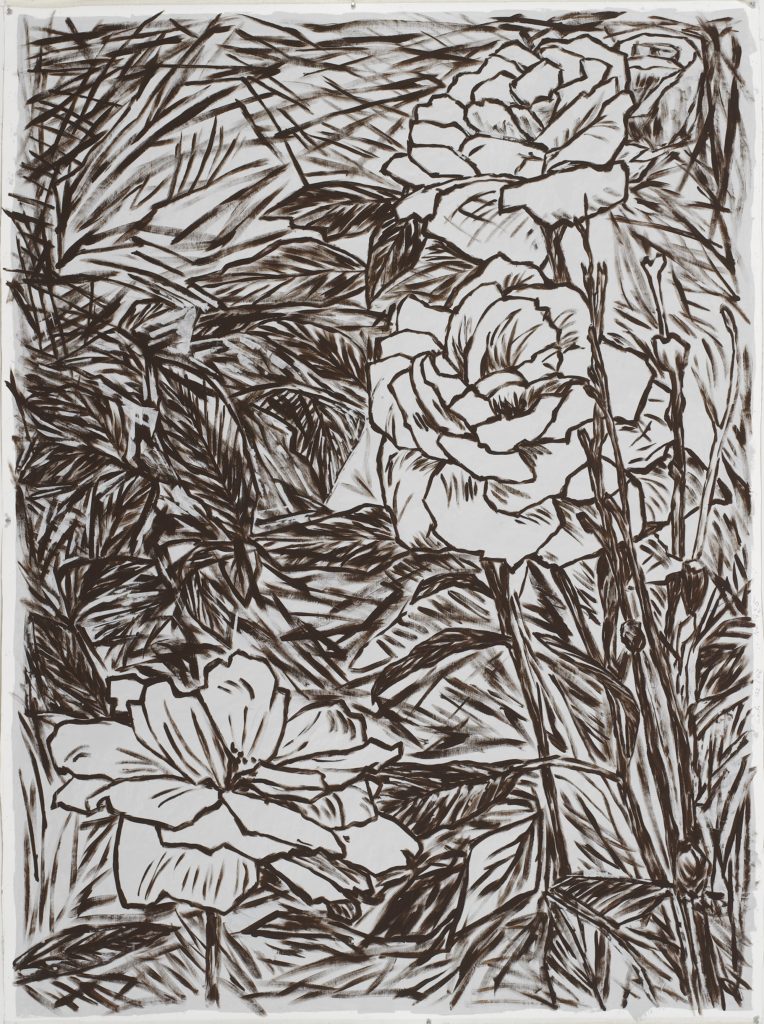
Anne Loch
AL 925, 2002
Acrylique sur toile
200 × 142 cm
Collection privée
Photo : Dominique Uldry, Berne
An oeuvre long kept in the shadows
After leaving Switzerland in 2002, Anne Loch continued her work in Germany, still maintaining her distance from galleries and institutions. Her paintings evolved: white backgrounds became more prominent, while her colours ranged from bronze, black and blue to a deep red. Sheep, deer, trees and large abstract forms joined the flowers and landscapes.
Diagnosed with cancer in 2013, she returned to Graubünden, settling in the Bregaglia Valley, where she continued working on her photographs and writings until her death in April 2014.
Her complete artistic estate is now held in Bern. The exhibition at the Zentrum Paul Klee makes it possible to appreciate the full scale and coherence of her work.
Painting as an open question
The exhibition title, Painting: So What?, perfectly reflects Anne Loch’s attitude. It is a direct, almost provocative way of asserting painting’s independence from the obligation to narrate, explain or convey a message.
Her paintings offer few answers. Instead, they invite us to slow down, observe and accept uncertainty. Somewhere between reality and dream, abstraction and figuration, attraction and distance, Anne Loch’s work reminds us that looking at a painting can still be a profoundly unsettling experience.
Practical informations
Anne Loch. Painting: So What?
18 July–20 September 2026
Zentrum Paul Klee
Monument im Fruchtland 3
3006 Bern
Tuesday–Sunday: 10 am–5 pm
Closed on Mondays